![[CITYPNG.COM]Waving American Flag Background - 1500x1500.png](https://static.wixstatic.com/media/af4a79_b6776c7bc3d54f9bbb2fa7016b6c148d~mv2.png/v1/crop/x_10,y_333,w_1490,h_705/fill/w_596,h_282,al_c,q_85,usm_0.66_1.00_0.01,enc_avif,quality_auto/%5BCITYPNG_COM%5DWaving%20American%20Flag%20Background%20-%201500x1500.png)


Empowering Navajo Veterans through Service - Part 1
July 15, 2026
DAV Expands Its Mission of Service
to Navajo Veterans Across Arizona
DAV National Commander Coleman Nee traveled to the Navajo Nation to see how the Department of Arizona is advancing DAV’s primary mission: helping veterans and their families obtain the benefits and services they earned through military service. On Tuesday, July 14, National 2nd Junior Vice Commander and Department of Arizona Judge Advocate/PDC Glenn Hohman and Department Senior Vice Commander Rod Hage accompanied him to the new office at the Kayenta Town Hall Annex. There, he met Sara Josley, president of the All-Navajo Veteran Auxiliary (ANVA) and the Department’s liaison with the Navajo Nation. The Kayenta office brings free, professional claims assistance closer to Navajo veterans and their families. For veterans unable to travel to a remote office, Josley leads field visits to their homes, helping ensure that distance, mobility, and limited transportation do not prevent them from receiving support. These visits gave Commander Nee a firsthand view of the urgent needs facing Navajo claimants and the importance of meeting veterans where they live.


On July 15, Commander Nee observed claims assistance for Navajo veterans and survivors at the Pinon Veterans Wellness Center Hogan, the first remote service location established on the reservation. He met Barton Hosteen, assistant director of the center and commander of the Pinon Chapter of the Central Navajo Veterans Agency (CNVA), and saw how DAV chapter service officers guide claimants through the benefits process. Josley’s interpretation between English and Navajo is essential to providing clear, respectful, and culturally responsive service, particularly for older veterans. ANVA Vice President Walter Barrington will assist Josley as the Department prepares to open a third remote office in Ganado near the end of August 2026. Together, the Kayenta, Pinon, and Ganado locations will extend support across the northern, central, and southern regions of the Arizona portion of the Navajo Nation, strengthening DAV’s commitment to ensure that Navajo veterans, their families, and survivors can access earned benefits with dignity.

Rodney Hage, Department of Arizona Senior vice Commander, Glenn Hohman, Department Judge Advocate and National 2nd Junior Vice Commander, and Coleman Nee, DAV National Commander, at the remote office in Kayenta.

The group at the Pinon Veterans Wellness Center, including ANVA President Sara Josley (front, center) and Pinon Chapter Commander Barton Hosteen (in ball cap next to Commander Nee). IT TAKES A GREAT TEAM!

Of course, whenever we get together on the reservation, there is always time to share stories and laugh; therefore, the obligatory selfie!
July 10, 2026
Department of Arizona Featured in the DAV Magazine America 250 Issue!


June 16-18, 2026
Department Senior Vice Commander and Adjutant Install and Begin Operations of a Second
Navajo Nation Remote Claims Office in Kayenta
It was a beautiful Tuesday and a scenic drive from Phoenix to the Navajo town of Kayenta, not very far at all from the Utah border. Senior Vice Commander Rodney Hage and Adjutant/CEO Carl Forkner were on their way to provide a second remote claims office that serves Navajo Veterans in the northern areas of the Navajo Nation in Arizona. This office is a leased space in the Kayenta Township building where the Economic Development Office resides. DAV CSOs and DSOs will be providing remote claims services two days a week to start; this, combined with 2 days a week serving the Pinon site and 2 days a month serving the Globe rural community site, will be an enriching experience for our CSOs and DSOs, as well as providing services to one of the most underserved and unserved populations in America--our Native American Veterans and their families.

This is a photo of the welcoming area outside the Economic Development Office and our DAV office.
Another photo of the welcoming area outside the Economic Development Office and our DAV office.


Senior Vice Rod Hage working with our last Veteran of the day in the Kayenta DAV Claims Office.
Our hotel was "not bad" and was only 1/2 mile from our new office in the Kayenta Township Annex. The food was pretty good, especially breakfast, but one might consider carefully the choice of entree [LOL]. On a positive note, the cheesecake was delicious!
On the way to Kayenta, we took about a 10-mile detour to visit the Navajo National Monument Visitor Center, a part of the multi-state Monument Valley.


Another important event with our trip to Kayenta was the delivery of an SUV-full of clothing, towels, and shoes for the Navajo people. They were received by our Pinon site manager, Sara Josley, for distribution to families in need.
What does the future hold? We will be installing one more office--in Ganado, in the southern portion of the Arizona Navajo Nation in August. In September, we travel northwest to stand up a remote service office in Peach Springs to serve the Hualapai Tribe, south of the Grand Canyon. Then we come back to the northeast again in October to stand up a remote service office near Shongopovi (Second Mesa) on the Hopi Reservation.
In all, over a two-year period, we will install a dozen remote stations to serve our Native American Veterans and another three in rural areas off the reservations to serve our rural Veterans.

May 31, 2026
Department Adjutant Presents Keynote Speech
for Navajo Memorial Day Ceremonies
Navajo Memorial Day occurs each year on June 1st. This year, Department Adjutant & CEO Dr. Carl Forkner was invited by Nazlini Chapter Commander Dennis Dedman to give the keynote address for the ceremony that took place at the Nazlini Chapter House in Arizona's region of the Navajo Nation. In attendance were about 120 Navajo Veterans, family members, survivors, and members of the community.
The Memorial Day Ceremony began with the raising of the American Flag by Veterans dressed in the uniforms of their era of service. The Army, Air Force, Marine Corps, and Navy were all represented. The opening ceremonies were respectful and reverent, focused on the purpose we were all there--remembering all those who served and gave the last full measure of devotion.

The other keynote speaker for the day was Navajo Nation President Dr. Buu Nygren. He discussed the important contributions of Navajo service members and Veterans, not only throughout their military service, but through continued service to their communities. The Navajo people have a long tradition of taking care of each other--from having multi-generational homes to helping neighbors and other members of the community.
Following President Nygren's remarks, a ceremony was held where the memorial flags of Veterans were unfolded, open to the sunlight and breeze, and then refolded with the 13 folds of a memorial flag.

The keynote address included remembrance of the service, heroics, and dedication of Navajo service members in conflicts from the American Revolution to the World Wars, Korea and Vietnam, the Gulf War, Post-9/11 conflicts, and today's operations in the Persian Gulf.
While most Americans have heard about the contributions of the Navajo Code Talkers in winning the War in the Pacific during World War II, many do not know of the exploits of the Army's 45th Infantry Division, nicknamed the "Thunderbirds." A famed US Army National Guard unit, they spent 511 days in combat, fighting across the European Theater from Sicily to the Alps. The division executed four amphibious assaults, liberated the Dachau concentration camp, and suffered over 62,000 casualties, while taking over 100,000 prisoners. Around 2,000 Native Americans from 50 tribes served in its ranks.
Click to view video
Click to view video
Following the flag ceremony for each of the family members and surviving spouses, a group photograph was taken to remember the day that their family members were again honored by the Navajo Nation. Standing in front of the group of family members is Seraphine "Sara" Josley, President of the All-Navajo Veteran Auxiliary (ANVA) and DAV Department of Arizona coordinator for our remote claim stations in the Navajo and Hopi Nations.


At the end of the event, Department Adjutant & CEO Forkner had the opportunity to talk with President Nygren, who expressed his thanks for the attention and services Department of Arizona and ANVA are providing to Navajo Veterans.
April 24, 2026
Department Leaders Meet with the
Central Navajo Veteran Agency in Piñon
After giving a short briefing about the Department's current remote claim station project at Piñon and telling them about the program expansion because of the enormous interest and use by Navajo Veterans, we were invited to participate in discussions about the Central Navajo Nation community led by President Harrison Kee, followed by discussion about governance and working with the Navajo Nation President's office in Window Rock led by Tim Johnson (Navajo Veteran Liaison for the President of the Navajo Nation, Buu Nygren). Also discussed were plans for building a new, $30B "Warriors Home" for Veterans, with an included Veterans resource center that will provide resource information across a wide range of topics.

Of the 16 Chapter Commanders in the Central Navajo Veterans Agency, 12 were present at the council meeting. All were interested in our plans to expand into Kayenta (to the north), Ganado (to the south), and the Hopi Veterans Memorial Center near Shongopovi. This expansion will cut the time it takes for Veterans to travel to any of the remote claim stations--that means reducing drives that were up to four hours for some Veterans and survivors.

The council is blessed with 100% homemade food at lunch. Today it was mutton and corn soup, potato salad, lettuce salad, and fry bread!

At the Central Navajo Veteran Agency (CNVA) council meeting, Department Adjutant Carl Forkner and Department Senior Vice Commander Rod Hage presented Mr. Barton Hosteen, Commander of the Piñon Chapter and our host, with a plaque honoring the history of Navajo service and their continued service after the military.
The Department of Arizona Commander's Award for Excellence was presented to Sara Josely, President of the All-Navajo Veteran Auxiliary and our site coordinator for Piñon remote claim service operations.


March 25, 2026
by Craig McKee, ABC15 Phoenix
New remote claims program expands lifeline for Navajo Nation and rural Arizona veterans

Click on image to see video
The goal is to help veterans secure disability ratings, survivor benefits, and education benefits both for themselves and their families.
By: Craig McKee
Posted 9:31 AM, Mar 25, 2026
PHOENIX — A first-of-its-kind remote claims initiative launched by the Disabled American Veterans Department of Arizona is helping rural and tribal veterans file for the benefits they’ve earned without driving hours to the nearest service office.
The program, a roughly $50,000 investment over two years, outfits service officers statewide with 38 Windows 11 tablets, and 11 iPads, each paired with keyboard cases, styluses, and boxes of flash drives.
The equipment allows veterans in remote communities — including the Navajo Nation and the mining town of Globe — to connect by video with trained veteran service officers, turning what was once a five-hour trip into a computer call.
“It’s all about getting out of the chapter house, going into the community where the veterans are that can’t come to you,” said Dr. Carl Forkner, a veteran service officer and Adjutant of the DAV Department of Arizona. “If you’re in the Navajo Nation — Piñon or Chinle — you’re five hours away from the nearest service officer. That’s a long drive. That’s an overnight trip.”
Forkner said Arizona is the first state to roll out this kind of remote claims network for veterans, with other states already expressing interest, especially those with large Native nations and rural populations.
While veterans can technically file a claim online themselves, advocates say the process is complicated, easy to get wrong, and full of traps that can lead to denials or delays.
“They don’t speak VA,” Forkner said. “This program works very well, and it’s just like you’re sitting there with the veteran.”
Through the new system, veterans in communities such as Globe, Claypool, San Carlos, and Roosevelt Lake can walk into a local site — often a lodge, wellness center or community building — sit down at a dedicated computer and connect via Zoom to a DAV service officer anywhere in the state. After documents are transmitted and forms completed, the veteran leaves with a flash drive copy of their claim and the peace of mind that it was filed correctly.
The goal is to help veterans secure disability ratings, survivor benefits, and education benefits both for themselves and their families.
In Globe, Army veteran Linda Merlin is on the front lines of the rollout. She serves as the veteran liaison at the local Elks Lodge and as a veterans advocate with Veterans Affinity, a nonprofit focused on helping older veterans. “We look for the senior veterans to help them get their DD 214, their benefits, help get them a rating,” Merlin said. “They’re the ones that kind of got left out.”
Before the remote claims station arrived, Merlin said, most Globe-area veterans had to travel 68 miles to Mesa for help, often without reliable transportation.
“If you’re disabled and don’t have a car, you’re not going,” she said. “You have to have a friend or a family member to take you down.” Now, on designated days, veterans can come to the Elks Lodge, grab coffee — and likely cookies — and sit down at a computer that links them directly with a DAV service officer.
On the Navajo Nation, where an estimated 30,000 veterans live on or near the reservation, leaders say the remote DAV system is answering a desperate need.
“From the data we collect from our Navajo Nation VA office, that’s the number they work with,” said Dave Nez, chair of the Piñon Veteran Wellness Center, a 501(c)(3) nonprofit. “This is veterans that live on Navajo Nation as well as off Navajo Nation, but they still come here for services.”
He explains the new virtual connection helps in so many ways, even taking the large expense of traveling on a fixed income. “The ones that want to take the burden to travel — a lot of times overnight and spend their own money — those are the ones that go to Prescott or down to Phoenix to start their claims,” Nez said.
Bringing DAV claims workers in by video, he said, changes the equation. Veterans can now be scheduled in a series of appointments — 12:30, 1:00, 1:30 — without leaving their community. Nez said that is only the beginning.
“We’d like to really extend that to more advocacy as well,” he said. “Once the paperwork is done and submitted, it’s the follow-up that a lot of veterans don’t really take the time and effort for. A lot of them are lost because they need interpreters, they need transportation, they need funding to travel.”
For older Navajo veterans and widows, language barriers add another layer of difficulty. During one recent remote session, Nez watched as volunteers translated back and forth between English and Navajo so a widow could understand the survivor benefits she might be eligible for.
“Particularly the older veterans, they might be hard to hear, might have limited education,” Nez said. “So, you repeat the questions, translate into Navajo and then back to English. That was happening here.”
Nez said the wellness center concept his nonprofit is building goes beyond claims work. It is meant to address what he calls “insular veterans” — men and women who have returned home but remain emotionally and socially detached.
“These are veterans that are basically disconnected,” he said. “They’re still in their military mode, or they are isolated because of what they experienced. The reintegration process is difficult for them.”
The center aims to become a resource hub and safe space, where veterans can rebuild trust, regain confidence, and reconnect with their communities.
“We want to find everyone and help them make that adjustment, build that confidence back up into the community and be more productive,” Nez said. “They’re full of knowledge and expertise, but it’s just really bringing them back out gradually and kind of putting them back into the community as a normal person.”
The Piñon Veteran Wellness Center was formally organized only in early January, but its founders say the need has been evident for years.
For Barton Hosteen, a former Army military police soldier and reconnaissance specialist who served from 1989 to 2013, including two years in Iraq, the system’s shortcomings are personal.
When he returned from combat in 2006, he said, he struggled with trauma and couldn’t get along with anyone. Yet, on the Navajo Nation, there were virtually no local resources.
“We had zero — nothing. No benefits, nothing, claims worker, nothing,” he said. “So, I started going off the reservation, here and there. Prescott, Carl T. Hayden, all that. It took me almost five years to get to 100%.”
The constant travel, appointments and paperwork — often undertaken with his late wife — took a toll.
“It was really hard,” he said. “But finally, I got it — 50, 70, and 100. They got me to where I couldn’t work no more. Through VA, I cannot work. They pay me for it. They take care of me really good. So, I did that on myself.”
That experience, he said, convinced him that a wellness center in Piñon was essential.
“We want it here,” Hosteen said. “Let’s start from here. It was through me that this wellness center started. We found that it’s a need. That’s why we’re at this point.”
Asked if the new organization and remote claims access would save lives, Hosteen didn’t hesitate.
“Yes, sir,” he said. “That’s where we’re at now. We’re going to start getting what the veteran needs.”
The group is seeking funding and grants to move from a modest beginning toward a fully equipped wellness center offering claims support, counseling connections, transportation coordination and a welcoming space for military families. “Within the next few months, we’re looking for funding that could become available so that we can give better services, improve what we have here,” she said. “If somebody out there hears and says we do need this for the natives to come in and to heal, starting through here — that’s what we’re hoping.”
For Andrew Simpson, an 80-year-old Native American Marine Corps veteran of Vietnam, the journey to full disability has also been long and unfinished. “I came back fully alive, but not as good as I was when I went into the service,” Simpson said. He has filed and refiled for years, reaching 90% but still short of 100%.
He and his wife now use two computers at home to help other veterans start the claims process and understand spousal benefits. “A lot of times we’ll try to help the people that haven’t gotten their disability either,” he said. “We need your help. We need Veterans Administration’s help all over the world. That’s what we need.”
On the Navajo Nation, Saraphine Josley, president of the All Navajo Veterans Auxiliary, said her organization helped guide Nez and Hosteen’s group through the 501(c)(3) process because their missions were aligned. She envisions a one-stop resource center not just for Navajo veterans, but for non-Native veterans married into Navajo families and for military families more broadly.
“There’s no limit of who we can help,” Josley said. “We’d like this to be a one-stop place where they can feel confident, secure, and safe that they can get help here.” Her group and the Piñon Veteran Wellness Center operate as what she called a “mirror image of the Red Cross,” on call to respond when veterans or families need support.
Back in Globe, Merlin’s message is simple and direct:
“Come have coffee and donuts with us and let us help you. Let us help you by minimizing those barriers to care. Let us help you get to your doctor’s appointment. Let us help you sign up with the VA. Let us help you get that rating or those benefits, because we’re all volunteers, and we all have a purpose — and that’s to help other veterans. Nobody gets paid. We do this for the love of our fellow veterans.”
March 2, 2026
First Remote Claims accomplished today for Native American Veterans via videoconference with Piñon, AZ, in the Navajo Nation.
A major goal of the DAV Department of Arizona $30,000 Remote Claims Station project is to provide connectivity with Chapter and Department Service Officers via videoconference. On March 2nd, Past Chapter Commander and Department Adjutant | CEO Carl Forkner successfully conducted seven remote claims sessions with Navajo Veterans and surviving spouses, with four claims being written, two requests for DD-214s, and three were provided information and links to additional resources to assist them with their needs, including the National DAV Caregiver Program.
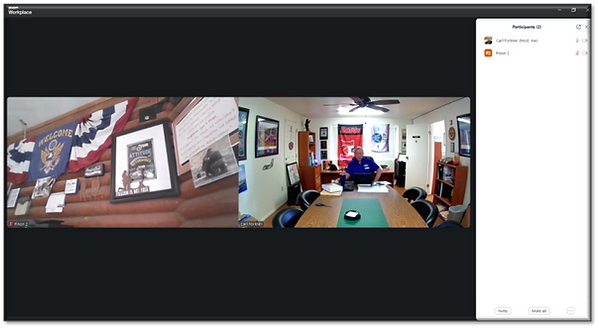


Many thanks to Craig McKee from ABC15 Phoenix for coming to the DAV Department of Arizona office to observe the remote claim program in action and also learn more about the other half of our initiative to provide remote service to Veterans--a $50,000 investment over two years, outfitting Service Officers with Windows 11 or iPad tablets, keyboard cases, and styluses that enable them to provide services away from the Chapter House to homebound, hospitalized, hospice care, and transportation challenged Veterans and their survivors.
February 11, 2026
First Remote Claims Station to increase access to Chapter Service Officers for Native American Veterans established today in Piñon, Arizona in the Navajo Nation.
A major part of the DAV Department of Arizona $30,000 Remote Claims Station project is to provide connectivity with Chapter Service Officers and Department Service Officers via videoconference. As many as nine remote claims stations are planned for around the state, with five of those being installed during the next two years. On February 11th, Past Chapter Commander and Department Adjutant | CEO Carl Forkner and Department Senior Vice Commander Rod Hage installed the first of our full remote station setup. What makes this different from the installation in Globe is that we installed two laptops, a printer/scanner, and a complete Starlink Internet system--which we activated and used during the last part of the installation. Future Native American setups will include this configuration.


There are 30,221 Veterans living in the Navajo Nation in the northeast part of Arizona, northwestern New Mexico, southern Utah, and southern Colorado. On April 24th, we have been invited to have the honor of addressing the combined meeting of all 16 of the Navajo Nation's Chapters and discuss the remote claims program and the many things that DAV can offer to this historically underserved population of true warriors who served their country with honor. I was told by the CEO of the USS Arizona Foundation--who also works with Navajo leaders to improve things for their Veteran community--that it is extremely rare that a "white man" (outsider) is invited to address leaders from across the Navajo Nation. Rod and I will be heading up there April 23rd for a presentation the following morning. I look forward with great excitement to the opportunity to meet so many faithful and honorable warrior leaders and learn more about them while I provide them with resources to support their needs.


These two pictures are special to Rod and I. On the left, Rod is standing with Seraphine "Sara" Josley, President of the All-Navajo Veteran Auxiliary, and Mr. Barton Hosteen, Vice Chair of the Pinon Veteran Wellness Center Group and Commander of the Pinon Chapter Veterans Organization. Sara was introduced to me by Chapter 1 Commander Christine Siegel--and then the coordination began! In less than two months from first contact to fully mission capable was an exciting time! Barton is an Iraq Veteran of the United States Army, and we enjoyed talking with him while the laptops were downloading software and doing updates. He also treated us to our first "Navajo Burger"--warning, bring a hearty appetite!
On the right is Jackie Burbank, a Vietnam Army Veteran who spent two years in country. We met him as he was sitting down to breakfast and we were getting ready to leave, We went over and paid our respects and got to talking with him. He has been a noble leader who people have looked up to for many years. In the photo on the right, he presented us with a framed memorial from when "The Wall That Heals" (the Vietnam Memorial traveling wall) was brought to the Navajo Nation for display. At the time, Jackie was the President of the organization that arranged for the display--the first time the traveling wall had ever been displayed on a Native American Nation's lands. It will be hanging in the Department office for anyone who wants to see it.
Let me finish by saying that many of us domesticated Westerners miss out on amazing adventures when we don't take time to recognize and listen to our Native American brothers and sisters tell us of not only their history as a nation, but also how our history was viewed through the eyes of their ancestors, Our hosts were fascinating and honorable people who have a huge heart for service to their communities. We've got nothing on them--in fact, we are a fabulous match to bring more service together as well as continue sharing our cultures.
And, by the way, some people say that the reservation is kind of a dumpy place... Well, I am glad that those people stay away because our drive through the Navajo Nation was absolutely beautiful. Miles and miles of lands untouched by factories, strip malls, clubs and fast-food joints. You could look out for miles and see Mother Nature at her finest, from the untamed land to the beauty of the sun's illumination of the hills and mountains, to the blue skies above unhidden from the smog and haze of a city. Spectacular!